Industry Report 2026: How Professional Services Firms Are Driving Growth in an Uncertain Market
.jpeg)

.png)
Introduction
In 2026, the market for IT services companies and consulting firms is evolving within an increasingly uncertain environment shaped by major economic, technological and geopolitical shifts. Following a pivotal year in 2025, professional services firms must now navigate slower growth, increased pressure on margins, and rising client expectations.
In this context, the key challenges are clear: identifying new growth drivers, demonstrating the value of engagements, integrating artificial intelligence, and adapting organisational models.
This 2026 industry report explores the key trends shaping the IT Services and consulting market, as well as the strategies required to remain competitive.
IT Services Firms in 2026: Growth Strategies in an Uncertain Market
Instability is no longer cyclical — it has become the new normal. The IT services and consulting market is entering a phase of moderate growth, characterised by constant trade-offs and heightened strategic discipline.
"I would not say that the market is declining; rather, it is returning to a level of normality after an exceptional period."
Damien Lasou Managing Director France, Expleo
Three key market realities in 2026
- Slower but more structured growth
- More frequent strategic decision-making
- Increased pressure on profitability
In this environment, IT services firms and consulting firms must adapt by activating new growth levers:
- geographic diversification
- sector expansion
- targeted external growth
Long-term planning alone is no longer sufficient. Leaders must adopt a rolling 12 to 18-month planning approach, enabling them to continuously reassess assumptions.
The challenge is no longer to wait for visibility, but to act with strategic assertiveness.
"This year is about focus, adaptation and expertise. The objective is not to spread ourselves thin across R&D or explore areas where we have less mastery, but rather to concentrate on our core capabilities, where we deliver the greatest value, in order to secure client engagements."
François Tourrette - Founder and Chief Operating Officer, BRAPI
The market is becoming more demanding, and it is essential for professional services firms to clarify their positioning and optimise their portfolio of activities and talent. This will enable them to adapt to evolving client expectations and diversify their offering.
Repositioning IT Services Firms: Meeting Evolving Client Expectations
In 2026, the balance of power has shifted towards buyers. Clients now expect:
- greater transparency
- measurable outcomes
- precise alignment between expertise and needs
From Daily Rates to Time-to-Value
The traditional model based on daily rates is being challenged. Clients increasingly prioritise Time-to-Value, measuring performance by how quickly and effectively results are delivered.

42% of executives now consider the ability to demonstrate ROI as the primary decision-making criterion.
The Rise of Smart Resourcing
Smart Resourcing is becoming the new standard:
- data-driven expert selection
- visibility on skills and availability
- precise matching to client needs
“A commercial pitch or the simple provision of resources is no longer sufficient."
François Tourrette – Founder and Chief Operating Officer, BRAPI
Sovereignty and Trust: New Differentiation Drivers
Trust is becoming a strategic asset for IT services firms and consulting firms.
It now relies on several key pillars:
- transparency
- skills ownership
- data security
- technological sovereignty

The Trusted Advisor is becoming an architect of meaning, ensuring effective execution.
"We place our primary focus on our clients’ processes and, above all, on delivering tangible business value."
Helmut Tiemann - Managing Director Business Technology Consulting AG
In an unstable geopolitical context, sovereignty becomes a key criterion in the choice of partners.
Issues of sovereignty will become decisive, more so than we might previously have imagined. The time for debate has passed; it is now a matter of taking action.
Laurence Laroche - Senior advisor (ex-La Poste et Saint-Gobain) et Présidente, Quartz-L
42% of IT services firms are already actively supporting clients on sovereignty-related issues.
Reassurance is essential to remove barriers to transformation. Sovereignty acts as both a psychological and regulatory prerequisite, given the clear expectations of client organisations.
To meet these expectations, organisations must:
- map their expertise precisely
- manage skills development
- ensure transparency in talent data
"Low trust at senior level can place entire service organisations at risk."
Sébastien Baert - Partner, Bignon De Keyser
The Impact of AI on IT Services Firms in 2026: Productivity, ROI and Transformation
Artificial intelligence is now at the heart of transformation in the consulting sector.
After a phase of experimentation, the challenge in 2026 is clear: delivering measurable economic impact.
Where do IT services firms stand with AI?
A “Popcorn Effect” is emerging:
- some firms are advancing rapidly
- others are struggling to scale
Three profiles can be identified:
- Pioneers: already benefiting from productivity gains
- Tacticians: facing a gap between leadership ambition and actual usage
- Cautious players: slowed down by regulation or cultural resistance
Top 3 AI priorities in 2026
- Driving internal adoption
- Measuring real impact and ROI
- Scaling autonomous AI agents
68% of firms report productivity gains, but only 16% measure a direct impact on margins.
AI enables organisations to:
- industrialise delivery
- standardise quality
- significantly reduce Time-to-Value
"The focus is clearly on improving both productivity and efficiency.."
Patrick Oelze - Partner, Grant Thornton
This standardisation leads to a reassessment of the profiles required for successful project delivery and disrupts the existing operating model.
Transforming the IT Services Operating Model in 2026
The rise of AI is fundamentally reshaping the organisational model of IT services firms and consulting firms.
The traditional pyramid model is evolving into a “diamond-shaped” structure:
- fewer junior roles focused on repetitive tasks
- greater reliance on senior expertise for high-value activities
A New Distribution of Roles
- Junior professionals bring technological fluency
- Senior professionals ensure strategic judgement and quality control
"We need to foster a real synergy between senior and junior professionals, which requires a cultural shift: seniors must accept and integrate the unique expertise that juniors bring to the table. This allows them to combine their expertise within a team environment to deliver optimised, service-oriented results."
Recardo Jackson - Executive Vice-President and Managing Director, MSG Group
One of the major human challenges this year is redefining human value. The combination of business expertise and AI skills is becoming the new standard. 90% of the executives interviewed consider critical judgement essential to validate AI outputs and make sound decisions in complex situations.
Continuous Upskilling Becomes Essential
"Skills are evolving. Today, the challenge lies in knowing how to interact effectively with systems, understand their outputs, and maintain a critical perspective on the results."
François Tourrette - Founder and Chief Operating Officer, BRAPI
Skills are evolving rapidly:
- interacting with AI systems
- interpreting outputs
- applying critical thinking
"Adaptability is no longer an individual quality. It has become an organisational prerequisite."
Damien Lasou - General Director France, Expleo
This trend is reinforced by the gradual disappearance of repetitive tasks. Organisations must rethink learning pathways to prevent skill atrophy.
Organisations must now manage skills as strategic assets in order to:
- anticipate future needs
- optimise resource allocation
- protect margins
Top 3 Trends for IT Services and Consulting Firms in 2026
Organisations must now reassess their approach to address the three key lessons of 2026:
- Constrained growth in an uncertain environment
- Increased pressure to demonstrate value
- Accelerated transformation driven by AI
Conclusion
In 2026, IT services firms and consulting firms must shift from agility to adaptability.
In a persistently uncertain environment, performance will depend on three key pillars:
- the ability to drive growth
- the capacity to demonstrate value
- the strategic integration of AI
The challenge is no longer to wait for stability to return, but to turn uncertainty into a sustainable competitive advantage.
In 2026, the fundamental challenge remains the ability to stay the course and turn instability into an opportunity for sustainable leadership by 2027.
.jpeg)
Client expectations in 2026: how professional services firms must rethink their value proposition
In 2026, clients of IT services firms and consulting firms expect greater impact, transparency and trust. Discover the key insights from the Napta study on evolving client expectations.

Why upskilling is critical for IT services companies in 2025: building future-ready workforces
Learn why upskilling is a strategic priority for IT services firms in 2025. Stay ahead of the rapid evolution in skills demands with actionable strategies and tools like Napta.
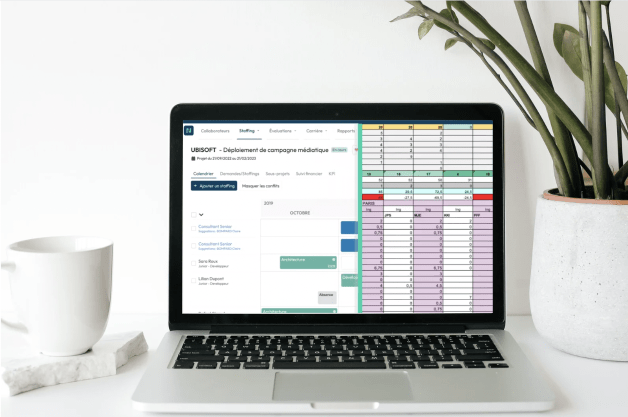
Why is Napta staffing software the best alternative to your Excel files?
Why choose Napta staffing software over Excel? If you thought that the latter was a good alternative, it is high time to change it!
Explore more resources




Turn resource management into the best business outcomes
A 100% free and no-commitment meeting to understand what Napta can help you with.