Client expectations in 2026: how professional services firms must rethink their value proposition
.jpeg)

.png)
Introduction
In 2026, against a backdrop of budget pressure, lasting uncertainty and rapid technological change, professional services firms must adapt both their commercial and operational approach. As explored in our article on growth strategies for professional services firms in 2026, clients now expect more than a promise of expertise: they want a clear, measurable value proposition that is directly linked to their business challenges.
For consulting firms, audit firms and IT services companies, three criteria are becoming essential:
- Mastering the right timing to enter the process: being present upstream, from supplier referencing phases to vendor panels and shortlists.
- Building a long-term relationship of trust: adopting a partner-led approach based on transparency, co-construction and quality of execution.
- Protecting credibility at every stage: ensuring consistency between the commercial promise, the profiles actually mobilised and the value delivered.
In this context, Smart Resourcing becomes a key lever for turning staffing into a driver of trust, transparency and client impact.
A) Moving from a volume-based model to an impact-based model
The traditional professional services model, based on time spent and billable days, is reaching its limits.
In 2026, clients are no longer buying execution capacity alone. They expect tangible results, demonstrable ROI and rapid impact.
“Becoming more cost-efficient is clearly a necessity today. In the current context, optimising our cost structures is no longer optional, but a strategic priority to preserve our competitiveness.” — Bernd Schulze, Director, Cloud, Data and AI Lead, Nagarro
This requirement is directly reflected in purchasing criteria: 42% of European leaders consider the ability to demonstrate the ROI of assignments to be a key decision-making criterion for buyers in 2026.
Clients want to know:
- what value the assignment will create,
- how quickly,
- and how that value will be measured.
Time-to-value is therefore becoming a new performance metric.
This shift is also transforming pricing models. One in two European leaders believes that pricing will evolve towards a hybrid model, combining a fixed fee with a variable component.

To remain profitable, firms must also industrialise what can be industrialised: automation, knowledge capitalisation, AI agents and the pooling of recurring tasks.
The objective: to focus human expertise where it creates the most value.
In an impact-driven model, performance depends on the ability to mobilise the right skills, at the right time, on the most strategic assignments.
This is the core challenge of Smart Resourcing: aligning skills, availability, commercial commitments and client impact.
B) Becoming a Trusted Advisor
In an unstable environment, clients no longer expect technical expertise alone. They are looking for a partner who can help them understand, arbitrate and make decisions.
Trust therefore becomes a strategic asset. It no longer relies solely on a firm’s reputation, but on its ability to reduce uncertainty and secure execution.
“Low trust at the top of the organisation can put an entire professional services firm at risk.” — Sébastien Baert, Partner, Bignon de Keyser, source: ProServicesDay 2025
Within executive committees, a lack of trust can slow decisions, dilute responsibilities and create a form of strategic paralysis.
The role of the firm is therefore evolving. It is no longer just about producing a recommendation, but about helping clients make sense of an environment saturated with information, tools and options.
The Trusted Advisor becomes an architect of meaning:
- filtering the noise,
- prioritising options,
- securing trade-offs,
- and ensuring consistency between strategy and execution.
“Clients rely heavily on our role as trusted advisors, especially in periods of uncertainty.” — Patrick Oelze, Partner, Grant Thornton
The Trust Equation reminds us that trust is based on a balance between credibility, reliability, intimacy and low self-orientation.

In this context, reliability becomes resilience, intimacy becomes psychological safety, and credibility becomes the ability to create meaning.
AI further reinforces this need for trust. It accelerates access to information, but it can also create opacity, over-delegation and a dilution of judgement.
The role of the Trusted Advisor is therefore not to compete with the algorithm, but to frame and govern its use.
In 2026, firms are no longer selling expertise alone. They are securing clients’ decision-making capacity.
C) Making sovereignty a new criterion of trust
In 2026, sovereignty is becoming an operational criterion of trust.
Long approached as a political or institutional topic, it is now becoming central to technology decisions, particularly around cloud, AI, data and security.
Clients are no longer just looking for high-performing solutions. They also want to understand:
- where their data is hosted,
- how it is used,
- which technology providers are involved,
- and how dependency risks are managed.
“Sovereignty issues are going to become decisive, even more than we currently imagine. This is no longer a matter for debate: we now need to take action.”
— Laurence Laroche, Former Procurement Director (La Poste and Saint-Gobain), President, Quartz-L
This expectation directly concerns professional services firms. Their role is to help clients arbitrate between technological performance, security, compliance and control over dependencies.
With AI, the issue becomes even more sensitive. Companies want to industrialise use cases, but they expect strong guarantees around model reliability, data integrity and processing traceability.
Sovereignty therefore becomes a prerequisite for moving from pilot projects to industrialisation.
According to the Napta 2026 Study, 42% of IT services companies now actively support their clients on sovereignty-related topics.
“The topic of trusted cloud and the need to operate in a secure environment is, in my view, one of the major challenges in today’s market.” — Xavier Muller, President, SFEIR
This shift requires greater control over the value chain:
- technology infrastructure,
- data management,
- partner ecosystems,
- critical skills.
Sovereignty also concerns human capital. Clients expect greater transparency around the expertise mobilised, its actual level and the firm’s ability to transfer know-how to internal teams.
For firms, this means improving skills mapping, managing upskilling and ensuring consistency between the profiles proposed and the challenges of the assignment.
Trust therefore no longer depends solely on the quality of delivery, but also on the ability to guarantee a controlled, secure and transparent framework.
Conclusion
In 2026, the winning value proposition for professional services firms is built around one clear requirement: demonstrating concrete impact while strengthening trust at every stage of the client relationship.
To achieve this, firms must clarify their positioning, secure their delivery and gain greater control over their resources, skills and ecosystems. The challenge is no longer simply to deliver expertise, but to become a partner capable of accelerating, arbitrating and creating measurable value.
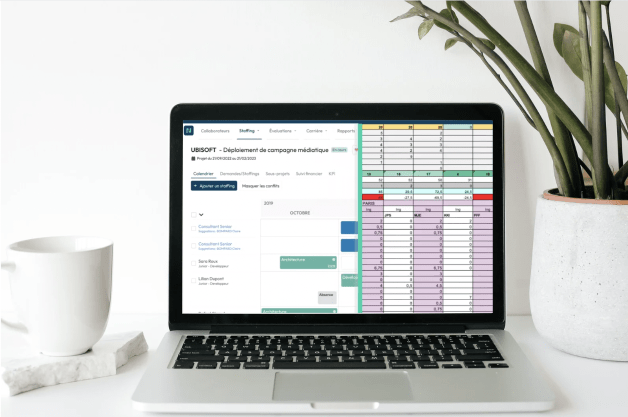
Why is Napta staffing software the best alternative to your Excel files?
Why choose Napta staffing software over Excel? If you thought that the latter was a good alternative, it is high time to change it!

Why can Excel no longer be your staffing tool in 2024?
Excel has proven itself, but once the thirty or so employees have passed, it is imperative to use software dedicated to the management of staffing.

What are the mistakes not to make in order to successfully manage change?
There are mistakes, often forgotten, that should not be made when you are managing change. Discover our tips for managing this stage in the best possible way.
Explore more resources




Turn resource management into the best business outcomes
A 100% free and no-commitment meeting to understand what Napta can help you with.