

The 2026 European Trends Report for Professional Services

2026 will be the year of transformation, adaptation and uncertainty as a new reality.
In an environment marked by a instability that has become a frame of reference, the managers of consulting, audit and IT firms face a complex equation: develop their activities while controlling their costs, reinforce the value delivered while adapting their operating models, and integrate AI without questioning the human foundations of the business.
Faced with client organisations with strengthened requirements and tighter budgetary arbitrations, the question is no longer whether professional services firms have a role to play (the need for expertise remains more present than ever) but how should their model evolve.
This study, based on testimonies from sector leaders, explores three structuring axes: the strategic decisions of managers, the evolution of customer expectations in a constrained context, and the redefinition of practices through new technologies.
Happy reading.
5 décisions stratégiques à prendre en 2026

To be discovered in the report
Managers of consulting, audit and IT firms will find in this study elements of answers to an ever more complex equation, based on four concrete realities.

Economic discipline is essential as a structuring criterion
Pressure on margins, ROI requirements, tight budgetary decisions on the customer side, cost control and resource allocation are now the first levers of profitability.

Value is moving from execution to strategic advice
Pressure on margins, ROI requirements, tight budgetary decisions on the customer side, cost control and resource allocation are now the first levers of profitability.

AI has gone from buzz to ownership
The challenge for 2026 is no longer adoption, but industrialization and the demonstration of a tangible economic impact, without questioning the human foundations of the profession.

Operational models are in transition, not disrupting
Whether it is the transformation of the pyramid model, the experimentation of new economic models (package, success fees) or skills-based approaches, changes are underway but remain gradual.
The Methodology

Qualitative interviews with European leaders in the sector
15 in-depth interviews including 12 with managers of service companies (Nagarro, Interpath, Wavestone, Grant Thornton, SFEIR...) and 3 experts in the sector.

Quantitative survey with professionals (consulting, audit, IT services)
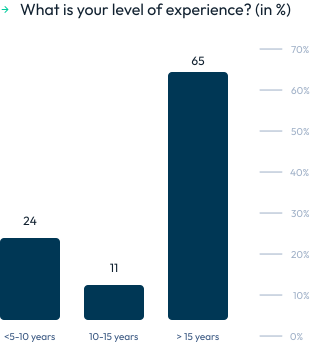
More than 300 respondents from consulting (45%), IT services companies (39%) and audit (16%), representing companies of all sizes.

External sources (content, sectoral reports, international studies, etc.)
Enrichment of the study by analysing sectoral data from reference organizations (Numeum, Eight Advisory, McKinsey, Consulting Insider...).


Data & AI DACH



















.png)

.png)





Download the full report

About Napta
Resource and skills management platform for professional services companies.

Press contact
For questions about the study or to organise a presentation of the results.
